
Modern ships rely on countless mechanical processes to operate safely and efficiently, and one of the most critical technologies behind this reliability is hydraulic power. From steering massive cargo vessels to operating cranes and anchor winches, marine hydraulic systems form the backbone of shipboard machinery. In this article, we’ll break down how these systems work, their key components, and why they remain the preferred choice for marine engineers across the shipping industry.
What Are Marine Hydraulic Systems?
At their core, hydraulic systems use pressurized fluid to generate force and motion. On board a ship, this principle is applied to move heavy loads, control steering mechanisms, and power deck equipment with precision. Unlike electrical or purely mechanical systems, hydraulic setups can generate immense force in a compact space, making them ideal for the tight, demanding environments found on vessels.
When integrated with Electrical Systems, Lighting & Electronics, these hydraulic systems enable more efficient control, monitoring, and operation of critical onboard functions without changing their core performance.
These setups are engineered to withstand harsh sea conditions, constant vibration, and exposure to saltwater, which is why their design differs significantly from industrial hydraulic systems used on land.
Key Components of Ship Hydraulic Systems
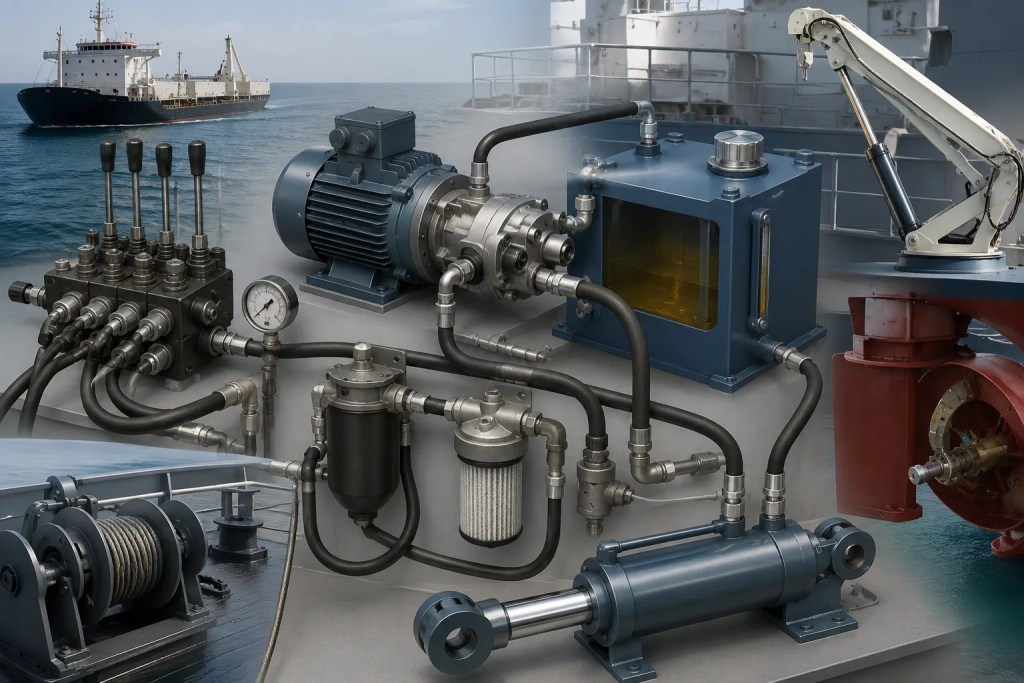
To understand how these systems function, it helps to look at their essential parts. The hydraulic pump serves as the heart of any hydraulic setup, converting mechanical energy from an engine or electric motor into hydraulic energy by pressurizing fluid, which is then sent through the system to perform work. This pressurized fluid, known as hydraulic fluid, is a specialized oil that transmits power throughout the system. It must resist temperature extremes, prevent corrosion, and maintain viscosity even in freezing or tropical marine climates.
Cylinders and actuators then take over, converting hydraulic pressure into linear or rotary motion and allowing equipment like rudders, cranes, and winches to move as intended. Valves and control systems regulate the flow and direction of hydraulic fluid, giving operators precise control over speed, direction, and force. Finally, reservoirs and filters play a supporting but essential role: the reservoir stores hydraulic fluid, while filters remove contaminants that could damage sensitive components over time.
How Marine Hydraulic Equipment Work on a Vessel
The working principle behind marine hydraulic equipment is based on Pascal’s Law, which states that pressure applied to a confined fluid is transmitted equally in all directions. The process begins when the hydraulic pump draws fluid from the reservoir and pressurizes it. From there, valves direct this pressurized fluid toward the required actuator or cylinder, controlling exactly where the force needs to go.
The actuator then converts this pressure into mechanical movement, such as turning a rudder or lifting an anchor. Many of these hydraulic functions also operate alongside Electrical Systems Lighting & Electronics, ensuring reliable control, monitoring, and coordination of onboard equipment. Once the work is done, the used fluid flows back to the reservoir, where it is filtered and reused in a continuous loop. This closed-loop design ensures efficiency, minimal fluid loss, and consistent performance even under heavy loads.
Common Applications on Modern Vessels
Marine hydraulic systems are used across nearly every major function on a ship. Steering gear systems rely on them to enable precise rudder control, even on massive tankers and container ships, while anchor windlasses depend on hydraulic force to raise and lower heavy anchors safely. Deck cranes and winches use the same technology to handle cargo loading, mooring lines, and equipment deployment. Watertight doors and hatches are powered hydraulically to ensure quick, reliable sealing during emergencies, and stabilizer fins use hydraulic actuation to reduce vessel roll for improved comfort and safety at sea. Ramps and cargo doors, common on ferries and RO-RO vessels, also depend on hydraulic power for loading vehicles efficiently.
Because these systems handle such a wide range of tasks, their reliability directly affects a vessel’s operational safety and efficiency.
Why Marine Hydraulic Systems Are Preferred Over Alternatives
Shipbuilders and engineers consistently choose hydraulic technology over purely mechanical or electrical alternatives for several reasons. One major advantage is their high power-to-size ratio, meaning hydraulic systems deliver significant force without requiring large, bulky components.
They also offer precise control, allowing operators to fine-tune speed and force through simple valve adjustments. Durability is another key factor, since these systems are built to endure constant exposure to moisture, salt, and temperature swings. In addition, hydraulic systems deliver consistent performance under load, reliably handling heavy or variable weights, while typically requiring less maintenance than complex electrical drive systems due to having fewer components that can fail.
These advantages explain why hydraulic technology remains dominant in critical shipboard applications, despite advances in electric and hybrid propulsion systems.
Maintenance Considerations for Marine Hydraulic Systems
Like any mechanical system, regular upkeep is essential to keep hydraulic components functioning properly. This typically involves routine fluid analysis to check for contamination or degradation, along with regular inspection of seals and hoses for leaks or wear.
On vessels equipped with yacht automation systems, many performance indicators and maintenance alerts can be monitored in real time, helping crews identify potential hydraulic issues earlier. Engineers also monitor pump pressure and performance metrics closely, replace filters at scheduled intervals, and check for corrosion in metal fittings and cylinders.
Preventive maintenance not only extends the lifespan of shipboard equipment but also reduces the risk of unexpected failures at sea, where repairs can be costly and time-sensitive.
The Future of Hydraulic Technology in Marine Engineering
As the maritime industry moves toward automation and eco-friendly operations, hydraulic technology continues to evolve. Modern designs now incorporate smart sensors, real-time monitoring, and energy-efficient pumps that reduce fuel consumption. Some vessels are even integrating hybrid systems that combine electric and hydraulic power for optimal performance.
Despite these innovations, the fundamental engineering principles remain unchanged. Whether on a small fishing vessel or a massive container ship, these systems continue to prove their worth through reliability, strength, and precision.
FAQs
Their main purpose is to convert mechanical or electrical energy into hydraulic power, which is then used to operate steering gear, cranes, winches, and other heavy equipment on board a vessel.
Most systems use specially formulated hydraulic oil designed to resist corrosion, maintain viscosity across extreme temperatures, and perform reliably in humid, saltwater environments.
Fluid condition should be inspected regularly, typically during scheduled maintenance intervals, with full replacement recommended once contamination or degradation is detected through fluid analysis.
Yes. These systems are specifically engineered to handle constant vibration, pressure changes, and harsh marine environments, making them well suited for rough seas and demanding operational conditions.
The biggest advantage is their high power-to-size ratio, allowing them to generate significant force through compact components, which is especially valuable in the limited space available on a vessel.
Yes, failures can occur, most commonly due to fluid contamination, worn seals, or leaks in hoses and fittings. Routine inspection and preventive maintenance significantly reduce these risks.
Conclusion
From steering control to cargo handling, boat hydraulic systems play an indispensable role in keeping modern vessels operational and safe. Their ability to generate immense force in compact, durable components makes them irreplaceable across countless shipboard applications. Companies like CF Boatworks have helped drive this reliability forward, delivering hydraulic solutions built for the demands of real-world marine use. As maritime technology advances, these systems will continue to adapt, remaining a cornerstone of marine engineering for years to come with CF Boatworks positioned at the forefront of that progress.
Understanding how these systems function not only helps ship operators maintain their vessels more effectively but also highlights why hydraulic technology remains a trusted solution across the global shipping industry.